

IPv4 vs IPv6: The Future of Internet Protocols
Every internet user these days must have come across the terms IPv4 and IPv6. You might have heard people say that IPv6 is better than IPv4 and information technology is the future. Just what exactly practise the terms IPv4 and IPv6 stand up for, and what is information technology that makes the latter one superior? If y'all're baffled by the same questions, well then read on, equally we discuss IPv4 vs IPv6, and take a improve look at the world of Internet Protocols. But first, let us talk over what are Net Protocols.
What is IP?
The Internet Protocol or IP is the main communications protocol in the field of Cyberspace protocol suite for relaying datagrams across network boundaries. The Cyberspace Protocol has a routing function that enables inter-networking between various devices across the globe, and effectively, establishes the network that we call the internet. The IP is responsible for addressing hosts, encapsulating data into datagrams, and routing datagrams from a source host to a destination host across ane or more than IP networks. In Lehman terms, IP contains the set of rules and guidelines that need to be followed while transmitting whatsoever data over whatsoever network spectrum.
IPv4 vs IPv6: What Practice They Mean?
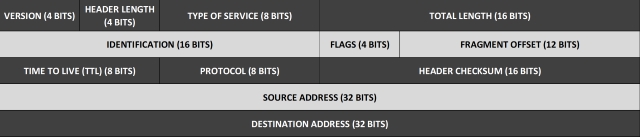
Internet Protocol Version four (IPv4) is the fourth-version of the Internet Protocol (IP). It was initially deployed for product in the ARPANET in 1983 and has since then grown to route about of the Internet traffic today. IPv4 is a connectionless protocol which is implemented on networks that brand use of packet switching. It operates on the best try delivery model, meaning that they obtain unspecified variable bit rate and commitment time, depending on the current traffic load. It does non guarantee delivery, nor does it assure proper sequencing or avoidance of duplicate delivery.
Net Protocol Version 6 (IPv6) is the most recent version of Internet Protocol and the incremental update to IPv4. Essentially, IPv6 is an Internet Layer protocol for parcel-switched internetworking and provides end-to-finish datagram transmission beyond multiple IP networks, closely adhering to the pattern principles developed in the previous version of the protocol. IPv6 was first formally described in the Internet standard document RFC 2460, published in December 1998, but has started coming into beingness on devices since belatedly 2006.

IPv4 vs IPv6: Detailed Differences
| IPv4 | IPv6 | |
|---|---|---|
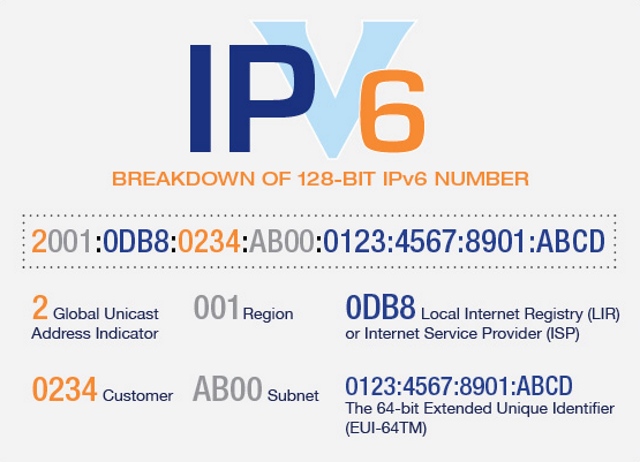
| Address | 32 bits (iv bytes) 12:34:56:78 | 128 bits (16 bytes) |
| Example | 12:34:56:78 | 1234:5678:9abc:def0: 1234:5678:9abc:def0 |
| Bundle size | 576 bytes required, fragmentation optional | 1280 bytes required without fragmentation |
| Packet fragmentation | Routers and sending hosts | Sending hosts only |
| Packet header | Does non identify packet menses for QoS handling Includes a checksum Includes options upwardly to xl bytes | Contains Catamenia Label field that specifies packet flow for QoS handling Does not include a checksum Extension headers used for optional information |
| DNS records | Address (A) records, maps host names Arrow (PTR) records, IN-ADDR.ARPA DNS domain | Address (AAAA) records, maps host names Pointer (PTR) records, IP6.ARPA DNS domain |
| Address configuration | Transmission or via DHCP | Stateless address autoconfiguration (SLAAC) using Internet Control Message Protocol version 6 (ICMPv6) or DHCPv6 |
| IP to MAC resolution | broadcast ARP | Multicast Neighbor Solicitation |
| Local subnet group management | Net Group Management Protocol (IGMP) | Multicast Listener Discovery (MLD) |
| Broadcast | Yes | No |
| Multicast | Yes | Aye |
| IPSec | optional, external | required |
Why The Need For IPv6?
IPv4 uses just 32 $.25 for its Net addresses. What this essentially means is that IPv4 can support up to2^32 IP addresses in total, which accounts tofour,294,967,296 (four.29 billion). While this does seem to exist a big number, the estimated number of devices that connect to the internet exceed 20 billion, and the number seems to be growing day by day. Equally such, the IP address for any device needs to be specific and unique, and with the growing number of users, we are running out of IPv4 addresses.
The IPv6, on the other mitt, makes use of 128-fleck internet addresses. This means that the protocol can support upwardly to 2^128 IP addresses in full, which roughly comes out to exist340,282,366,920,938,000,000,000,000,000,000,000,000 (3 hundred forty undecillion, two hundred 80-two decillion, iii hundred 60-half dozen nonillion, nine hundred xx octillion, nine hundred thirty-viii septillions) (yes, that'due south right!) . Substantially, the IPv6 standard is more than than plenty to keep the Internet operational for a very, very long time.
Benefits of IPv6
The IPv6, along with increasing the number of addresses available, does come along with furthermore added benefits. With the assistance of IPv6, the need for Network Address Translation (NAT) has been eradicated, which was previously used to conserve global address space allocations due to the lack of IPv4 addresses. Additionally, the IPv6 as well removes the possibility of private accost collisions, along with better multicast routing.
As compared to the IPv4 standards, IPv6 has a simpler header format, which allows for simpler and more efficient routing. It too brings nigh an increase in the Quality of Service (QoS), also referred to as "catamenia labeling". Not to forget, the IPv6 has its ain congenital-in authentication and privacy support and has flexible options with support for extensions. Overall, the IPv6 provides easier administration also, bidding adieu to Dynamic Host Configuration Protocol (DHCP).
IPv4 to IPv6: The Switch
The depletion of IPv4 had been predicted years agone. In 1993, Classless Inter-Domain Routing (CIDR) was introduced, which was subsequently replaced with the extensive utilise of Network Address Translation (NAT). While both the methods worked, they were nothing just temporary means to filibuster the IPv4 address exhaustion. Essentially, the switch to IPv6 is necessary, but the progress has been slow. To make the switch, software and routers require changes to back up the more advanced network, which will take fourth dimension and coin.
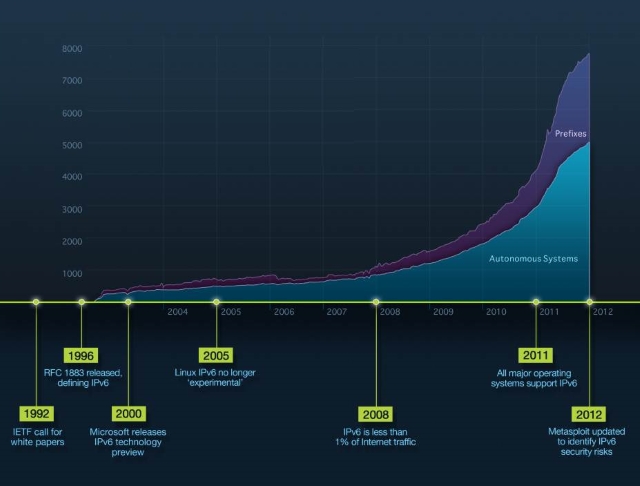
As of 2014, IPv4 still carried more than 99% of worldwide Internet traffic. Despite a decade long development and implementation history as a Standards Track protocol, general worldwide deployment of IPv6 is increasing slowly. As of 22 July 2017, the percentage of users reaching Google services with IPv6 reached xx.1% for the first fourth dimension, growing at well-nigh 7.2% per twelvemonth, although varying widely by region. While devices are adopting the IPv6 standards, the number of network providers switching to IPv6 is still quite low. In the meantime, IPv4 and IPv6 effectively run as parallel networks, though exchanging data betwixt these protocols requires special gateways.
SEE ALSO: What is Nighttime Web and How to Access it?
IPv4 vs IPv6: The Inevitable Change
The lack of IPv4 addresses is here, simply thankfully, we have the IPv6. With ii^32 addresses (I am not going to quote the exact number once again), the IPv6 standard should easily stand the test of time. All the latest devices come with IPv6 every bit their standard, and fifty-fifty if you lot haven't noticed it, chances are that you've already made the switch to IPv6. The switch to IPv6 is necessary and inevitable, one that you are jump to make presently. Or, to be honest, considering that the devices around you as well as your Internet access provider have already switched to information technology, you too volition make the switch.
So that'southward all there is to the discussion of IPv4 vs IPv6. Tell us your thoughts on the side by side big thing in the globe of Internet Protocol in the comments department below.

Source: https://beebom.com/ipv4-vs-ipv6/
Posted by: blossstrable.blogspot.com
0 Response to "IPv4 vs IPv6: The Future of Internet Protocols"
Post a Comment